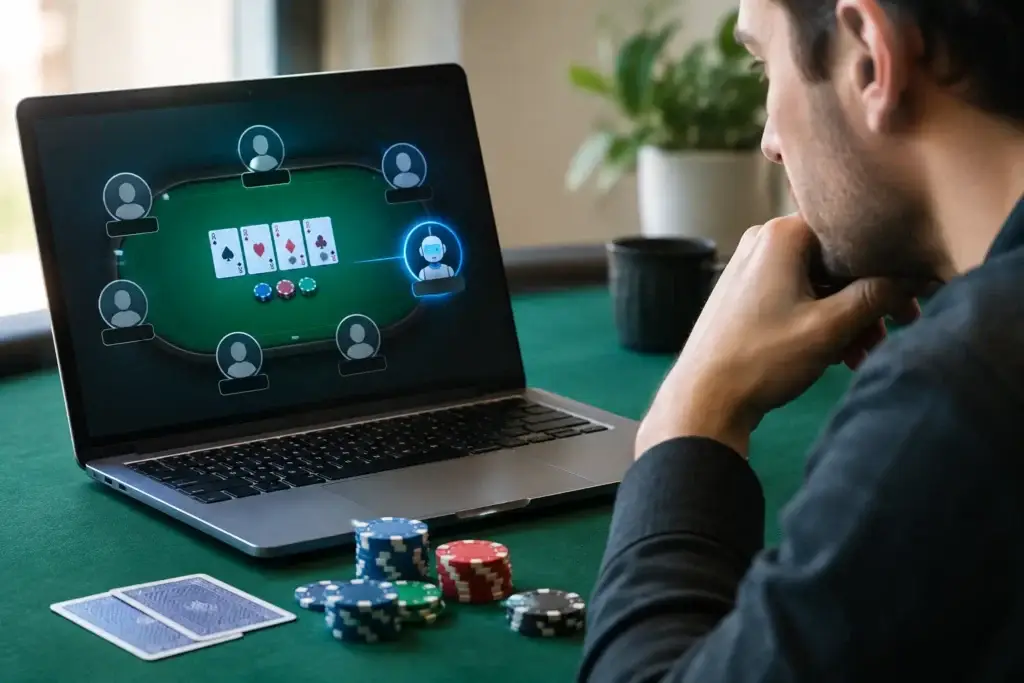
A suspicious opponent costs more than one pot. If an account is automated, or being heavily assisted in a way the room does not allow, it can distort the games you are choosing for your bankroll. Knowing how to identify poker bots is not about blaming every tight regular who makes a thin value bet. It is about spotting repeatable patterns, documenting what you see, and playing on rooms that take game integrity seriously.
For serious recreational players and grinders, the goal is simple: do not turn a hunch into a false accusation, but do not ignore evidence that changes where and how you play.
What a Poker Bot Usually Looks Like
A poker bot is software that makes decisions automatically or semi-automatically. Its quality can range from a primitive preflop script to a sophisticated program that uses large hand histories, fixed strategy trees, and fast calculation. Some suspicious accounts are not fully automated at all. They may be human-operated accounts using prohibited real-time assistance, shared databases, or an organized team strategy.
That distinction matters because a bot does not always play perfectly. In fact, many automated accounts are mediocre. They may play a predictable, low-variance strategy, fold too often to certain lines, or use sizings that are technically consistent but poorly adapted to the table. A strong human regular can also be disciplined, fast, and hard to exploit. One unusual hand proves almost nothing.
The strongest case comes from several signals lining up over a meaningful sample.
How to Identify Poker Bots at the Table
Start with behavior you can observe across hands, sessions, and stakes. A single timing tell or a strange river call is noise. Repeated behavior that does not fit a human decision-making process deserves closer attention.
Watch for mechanical timing patterns
Bots often act with nearly identical delays in routine spots. For example, an account may take exactly two or three seconds to fold, call, or raise regardless of whether it faces a simple preflop decision or a complex river bet. A human player’s pace naturally shifts when multi-tabling, facing an all-in, reconnecting, typing in chat, or considering an unfamiliar line.
Do not overrate speed alone. Plenty of experienced online players make standard decisions quickly, especially at lower stakes where spots repeat constantly. The concern is uniformity: the same narrow timing range over hundreds of decisions, with no obvious pauses in difficult spots.
Study sizing, not just results
Look for bet sizes that appear copied from a rigid decision chart. Common examples include the same unusual open size from every position, identical continuation-bet percentages on disconnected and coordinated boards, and fixed river sizes that ignore effective stacks.
A bot-like account may also use precise, awkward amounts repeatedly, such as 33.3% pot or 74.8% pot, across many tables. That is not automatic proof. Modern strategy-aware players use structured sizing systems too. The question is whether the player ever departs from that system when table conditions make an adjustment obvious.
If a player keeps using the same line against calling stations, short stacks, or clear overfolders, they may be following a script rather than responding to opponents.
Check the schedule and volume
An account that plays long, highly consistent sessions every day can be worth monitoring. Bots do not need sleep, tilt breaks, meals, or schedule changes. They may appear at the same stakes for 12 to 20 hours, often during low-traffic hours when fewer players are watching closely.
Volume is only a clue, not a verdict. Some grinders put in huge hours, and players in different time zones may look unusually active from a US perspective. Still, a schedule becomes more meaningful when it is paired with mechanical timing, repetitive sizing, and no signs of normal human interaction.
Look for unnatural table behavior
Humans make small operational mistakes. They sit out, miss a blind, adjust table counts, leave after a bad run, or change stakes. Suspicious accounts can display unusually clean and repetitive table management: instant seating, instant re-seating, consistent buy-in amounts, and rapid selection of the same game type every time a seat opens.
Chat is weak evidence. Many legitimate players never speak, particularly on international networks. But an account that ignores every interaction, never changes routine, and maintains the same pace through connection disruptions may add to a wider pattern.
Use Your Hand History Before You Make a Call
Your hand history is more useful than memory. Mark suspicious hands while playing, then review the account later. The objective is to identify statistical and behavioral consistency, not to relive a frustrating bluff catch.
Track the player’s position-by-position preflop ranges, 3-bet and fold-to-3-bet tendencies, continuation-bet frequencies, turn aggression, and river decisions. Compare those patterns with how the player responds to different opponents and stack depths. A real player can be fundamentally sound, but most humans show some drift, adaptation, or emotional variance over time.
A suspicious profile may have ranges and frequencies that are remarkably fixed while failing to exploit glaring leaks. For instance, it may defend the big blind at nearly the same rate against every open size, or continue betting at a preset frequency even after several opponents demonstrate they never fold. That kind of non-adaptation is more revealing than winning a few big pots.
Be realistic about sample size. Twenty hands tells you almost nothing. Even 200 hands can mislead you in low-frequency spots. Preflop patterns become useful earlier; river tendencies require much more data. If you use a permitted tracking tool, make sure it complies with the poker room’s rules. A tool that is allowed on one network may be prohibited on another.
Do Not Confuse a Good Reg With a Bot
False accusations are common because competent poker looks repetitive from the other side of the table. A good regular may use standardized preflop ranges, balanced bet sizes, and fast default decisions. They may also avoid chat and play long sessions. None of that is a violation.
The difference is context. Strong human players make adjustments. They may tighten when a table gets aggressive, isolate a weak player more frequently, alter sizes against short stacks, or slow down in a complicated spot. They also make occasional imperfect choices, because poker is not solved in real time by a person managing multiple tables.
Avoid letting results bias your judgment. If someone folds every time you bluff, that might mean they are a bot. It might also mean your bluffing line is transparent. If they call down light, they may be using unfair assistance, or they may have identified your tendency to overfire. Review the spot from both angles before assigning a cause.
What to Do When You Suspect a Bot
Do not confront the player or post an accusation in public chat. You gain nothing, and you may alert an operator before the poker room can investigate. Preserve the evidence instead.
Record the screen name, stakes, game format, dates and times, table names, and specific hand IDs. Note the pattern you observed, such as identical action timing over multiple sessions or a repeated sizing sequence that ignores stack depth. A report that says “this player is obviously a bot” is easy to dismiss. A report with 15 hand IDs and clear observations gives game integrity staff something to review.
Then use the poker room’s support or security channel. Reputable operators can examine data you cannot see: login patterns, device fingerprints, decision timing at a deeper level, account relationships, and unusual fund movement. They may not tell you the outcome of an investigation, but a serious room should acknowledge the report and have a visible policy against bots and prohibited assistance.
If you have strong concerns, leave the table while the matter is unresolved. Table selection is a bankroll decision. You do not need courtroom-level proof to decide a game is no longer worth your action.
Choose Poker Rooms That Make Fair Play a Priority
No network can credibly promise that suspicious accounts will never appear. The relevant question is how quickly and seriously it detects, investigates, and removes them. When comparing real-money poker rooms, look beyond a large welcome bonus or headline tournament guarantee.
Pay attention to the room’s reputation for security enforcement, its responsiveness to player reports, the quality of its traffic, and whether its games still offer a mix of recreational players and transparent regulars. Withdrawal reliability matters here too. A room that handles player funds and support poorly is not where you want to trust it with integrity complaints.
Poker Profit evaluates rooms through practical outcomes: playable traffic, game quality, promotions, mobile access, and reliable cashouts. Fair games belong in that same calculation. The best-looking bonus has no value if you are forced to question whether the action is clean.
Keep your process disciplined. Mark the hands, review the pattern, report credible evidence, and move your bankroll toward rooms that give you a reason to trust the games. Your edge is built through better decisions, and choosing where not to play is one of them.